
Applying for Polish, Italian or another citizenship through an ancestor who lived in Moselle, France? Consulates usually ask for official civil records — births, marriages, deaths — proving each link between you and that ancestor. I find those records in the Moselle archives, check that every link holds, and tell you exactly where and how to request the certified copies your file needs.
Free quote within 2 business days · Fixed price agreed before any research · Fully remote · Report in English on request
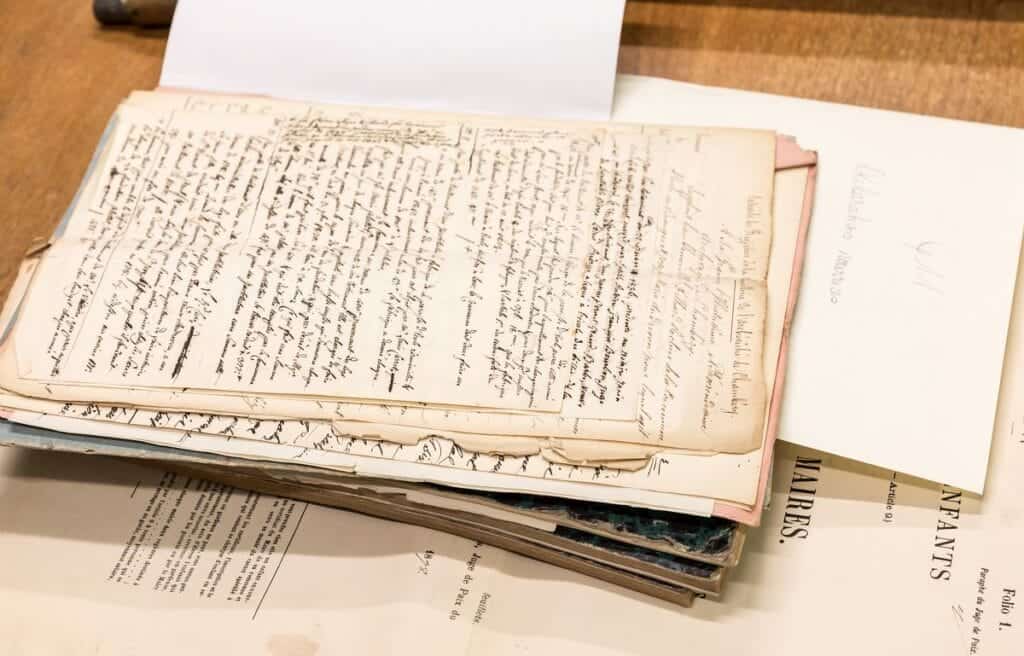
Why Moselle records can be hard to find
- Waves of immigration. Between the two world wars, many Polish families came to work in the Moselle coal basin (Forbach, Freyming-Merlebach, Creutzwald…), and Italian families settled in the iron and steel valleys around Thionville and Hayange. Their records are held in French town halls and archives, often with names written the French way.
- German-era records. From 1871 to 1918, and again in 1940–1944, Moselle was annexed by Germany. Many civil records from those years are written in German.
- Spelling variations. A Polish, Italian or German surname can appear in several forms from one record to the next. Each variant has to be checked, never assumed.
- Access rules. In France, birth and marriage records become public after 75 years. More recent ones are kept by the town hall and can be requested by the people entitled to them, such as direct descendants.
What I do for your application
- We define the chain of records. You tell me what the consulate asks for and what you already have. Together we list the links to prove, from you back to your ancestor.
- I search the archives. Civil registration, parish registers, censuses and, where relevant, military records — at the Moselle Departmental Archives (AD57) and online.
- I check every link. Names, dates and places are cross-checked between records. Anything uncertain is clearly flagged, never presented as certain.
- You receive a clear file. A written summary (in English on request), the records found with their exact archive references, and the list of certified copies to request, with the town hall that holds each one.
Pricing
Most citizenship files start as a custom investigation, from €150 for one precise question — for example, finding one ancestor’s birth record. Longer files are quoted on the basis of €55/hour for clients in France and €85/hour for clients outside France, always with a fixed price agreed in your quote before any research begins. Up to €150 included, full payment is due when ordering; above €150, a 30% deposit is due when ordering and the balance on delivery. Research starts once payment is received. Payments from abroad can be made by bank transfer or Wise, with bank fees paid by the client.
An honest word before you start
I am a genealogist, not a lawyer or an immigration adviser. Whether you qualify for citizenship is decided by the country you apply to, and its requirements (apostille, translations, deadlines) are best confirmed with its consulate. My role is to find the records, prove each link with sources, and tell you clearly what the archives can — and cannot — show.
FAQ: Moselle records for citizenship applications
My ancestor left Moselle a long time ago. Can the records still be found?
Very often, yes. Civil registration in Moselle goes back to 1792, and parish registers much further. Some records were lost or damaged, especially during the wars, so I always check feasibility before sending you a quote.
I only have a name and a rough date. Is that enough?
It is often enough to start. A village name, a birth year or a family story helps narrow the search. After a first look, I tell you honestly whether the lead is promising.
Can you obtain the certified copies for me?
For older records, I provide copies from the archives with their exact references. Recent birth and marriage records (less than 75 years old) can only be requested in full by the people entitled to them, such as direct descendants: I tell you exactly which town hall holds each record and what to ask for, so your request goes smoothly.
Can I receive my report in English?
Yes. Your report can be written in English on request. The records themselves are in French, German or Latin, and I point out the key information each one contains, using the standard wording these records follow.
How long does it take?
It depends on how many links need to be proven and on access to the records. You receive a realistic timeline with your quote, before anything starts.
Tell me about your ancestor
A name, a village, a rough date — whatever you know is a good start. I read every message myself and reply within 2 business days with a free, no-obligation quote.