
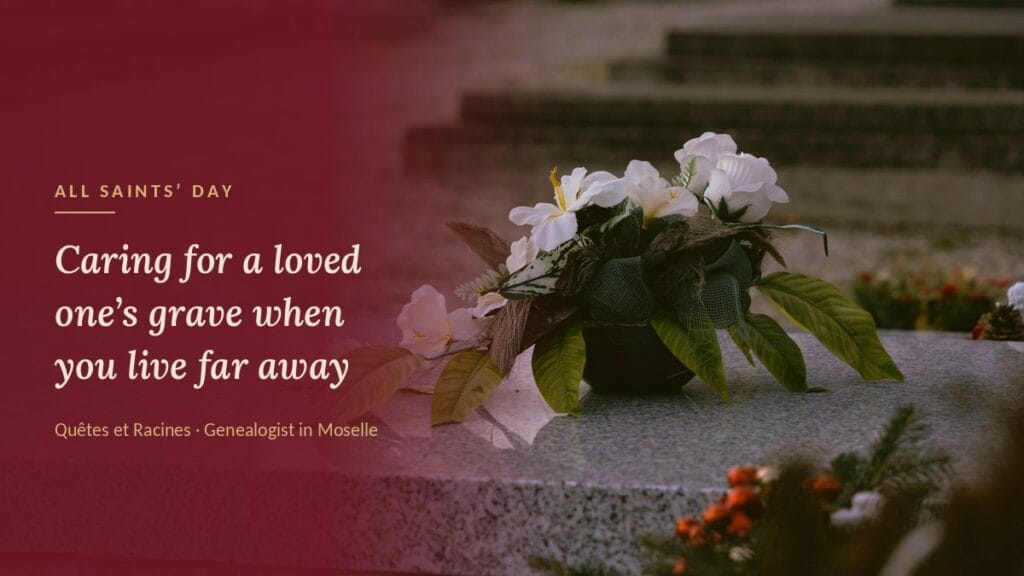
Every year, as 1 November approaches, many families face the same question: how can you lay flowers on a parent’s or grandparent’s grave when you live hundreds, or thousands, of miles away? Work, health, age or simply distance often make a visit to the cemetery impossible. Here are the options available, and how I can step in if the grave is in Metz, France, or within 50 km (30 miles) of the city.
All Saints’ Day, a date that matters in France
In France, All Saints’ Day (la Toussaint, 1 November) is still the time when families visit the graves of their loved ones to clean them and lay flowers, most often a chrysanthemum. Not being able to do so weighs on many families: you feel you are missing a duty, and you worry about the state of a grave you have not seen in years.
Your options when you live far away
- Ask a relative or a neighbour. It is the simplest option, but it depends on their availability, and you do not always get news about the grave’s condition.
- Have flowers delivered by a florist. Some florists will place an arrangement at the cemetery. The grave gets flowers, but it is not cleaned.
- Contact a stonemason or a funeral company. Some offer cleaning, especially for major work on the monument.
- Use a grave care service. Someone goes to the cemetery, cleans the grave, adds flowers if you wish and sends you photos.
Good to know: in France, the town hall does not maintain graves. Upkeep is the family’s responsibility, meaning the holder of the burial plot and their heirs.
Why upkeep matters
Moss, lichen, leaves and weather slowly damage a grave and make its inscriptions hard to read. More importantly, in France a grave left without care for a long time can be declared abandoned and taken back by the town after a formal procedure. Regular upkeep protects the grave, and with it the memory of those who rest there.
How it works with me
- You contact me with the name of the person buried, the town and, if you know it, the location in the cemetery. An old photo of the grave is very helpful.
- I send you a quote based on the grave and your wishes: one-off cleaning, a plan or flowers.
- I go to the cemetery and photograph the grave before doing anything.
- I clean the grave with respect for the monument and check its condition: inscriptions, joints, cracks.
- I lay the flowers if you have chosen this option, for example a chrysanthemum for All Saints’ Day.
- You receive a report with before-and-after photos, and I let you know about any problem I notice.
Everything is arranged remotely, with simple payment from abroad; the report and photos are sent by email.
How much does it cost?
Grave care costs €150 to €300 per visit, travel included, in Metz and within 50 km (30 miles). For a cemetery further away, just ask me whether it is possible. Plans of 3, 6 or 12 months (from €360 to €600) provide regular upkeep throughout the year. Seasonal flowers are available as an option.
For a visit before All Saints’ Day, please book before 25 October. I work alone, so the number of visits is limited. See my grave care service.
A genealogist’s eye
A grave is not just a monument to look after: it is also a trace of your family’s history. As a genealogist, I pay particular attention to the inscriptions. If a carving is fading or a plaque is damaged, I will tell you. And if you do not know exactly where the grave is, I know where to look: town registers, cemetery maps, family papers.
The photos you receive also become a keepsake to pass on. And if this grave makes you want to know more about the people who rest there, I can trace their story in the archives. Find out how hiring a genealogist in France from abroad works.
Frequently asked questions
Do I need to know the exact location of the grave?
It helps, but it is not essential. With the person’s name, date of death and town, the grave can often be found using the cemetery’s registers and maps.
Can I choose the flowers?
Yes. Tell me what you would like: a chrysanthemum for All Saints’ Day, an arrangement, a particular colour or the flowers your loved one liked.
Do I need permission from the town hall?
Usually not. If the town hall requires permission for work on the plot, I explain what to do. I follow each cemetery’s rules. Work on the monument itself is a job for a stonemason.
How will I know the visit has been done?
After each visit, you receive a report with photos of the grave before and after.
Illustration photo: Michael Pointner / Unsplash.