
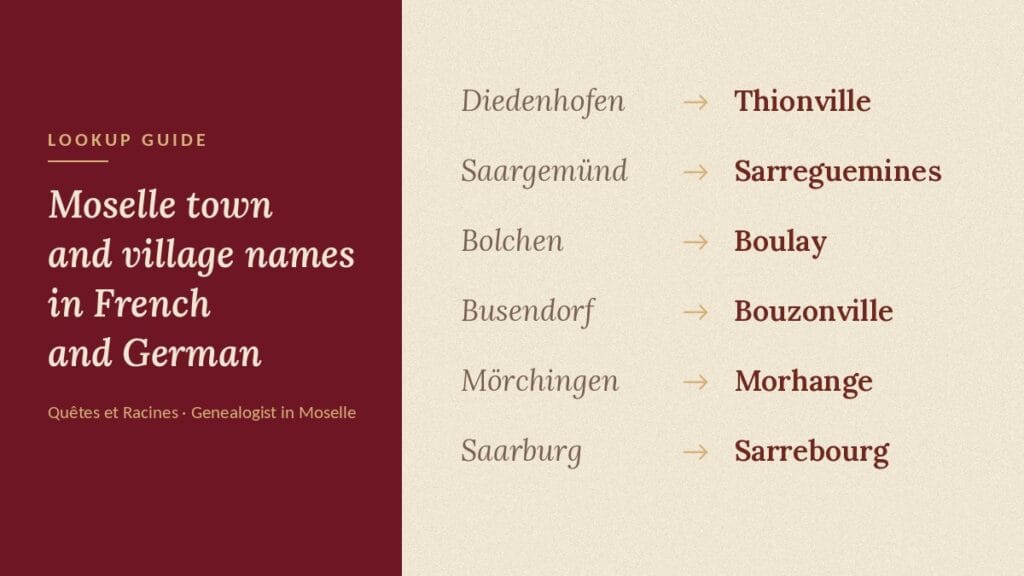
Your ancestor was born in “Diedenhofen”, “Saargemünd” or “Bolchen”… but you cannot find these places on a map of France? That is normal: many towns and villages in Moselle have, or had, both a French and a German name. This guide helps you match the German name found on a passenger list, a naturalization record or a family document with today’s French name, so you know which archives to search.
Why does my ancestor’s village have two names?
Moselle sits on the language border between French and German. In the north and east of the department, a Germanic dialect was traditionally spoken, and villages had German-sounding names long before 1871. In the area around Metz, people spoke French and the names were French.
History then added several layers:
- 1871–1918: Moselle was part of the German Empire. German names became official where they already existed. Most French-speaking villages kept their French names until 1915, when many of them were given German names.
- 1918: back in France, all towns took back their French names.
- 1940–1944: under the Nazi annexation, German names were imposed again, sometimes in new forms.
This is why a single village can appear under two or three different names depending on the date of the document. For records from the time of the great emigration waves, before 1914, the name used in the 1912 gazetteer of the German Empire is usually the right lead.
One more tip: the areas of Château-Salins and Sarrebourg belonged to the Meurthe department before 1871. If a record from before 1871 says “Meurthe”, the village may be in today’s Moselle.
How to read the names
Foreign clerks often wrote German names without umlauts: ü becomes ue or u, ö becomes oe or o, and ß becomes ss. Search for both spellings. A few recurring patterns will also help you:
- -ingen in German often corresponds to -ange in French (Hayingen / Hayange).
- -dorf often corresponds to -troff or -stroff (Albesdorf / Albestroff).
- -weiler often corresponds to -viller (Folschweiler / Folschviller).
- Groß means Gros or Grand, Klein means Petit, Ober means Haut, Nieder means Bas.
- Sankt or St. means Saint, and bei (near) often matches the French lès.
French–German lookup table
The table lists over 120 towns and villages of Moselle, in alphabetical order of their French name. On a computer, press Ctrl+F (or Cmd+F on a Mac) and type the name found on your document.
| French name (today) | German name(s) | Notes |
|---|---|---|
| Abreschviller | ✓ Alberschweiler, Albersweiler | |
| Albestroff | ✓ Albesdorf | |
| Algrange | ✓ Algringen, Olgringen | |
| Amnéville | ✓ Stahlheim, Ammenweiler | |
| Apach | ✓ Apach | Same name in both languages |
| Ars-sur-Moselle | Ars an der Mosel (Ars a. d. Mosel) | |
| Audun-le-Tiche | ✓ Deutschoth, Teutsch Oth, Teutsch Altheim | |
| Basse-Ham | ✓ Niederham | |
| Behren-lès-Forbach | ✓ Behren | |
| Bénestroff | ✓ Bensdorf | |
| Bertrange | ✓ Bertringen | |
| Bitche | ✓ Bitsch | |
| Boulay-Moselle | ✓ Bolchen | |
| Bousse | ✓ Buss, Bous | |
| Bouzonville | ✓ Busendorf, Bouzendorf | |
| Carling | ✓ Karlingen | |
| Cattenom | ✓ Kattenhofen, Kettenhoven | |
| Château-Salins | Salzburg, Salzburgen (1940–1944) | French name in 1912; German form introduced later (1915–1918 or 1940–1944) |
| Clouange | ✓ Kluingen | |
| Cocheren | ✓ Kochern | |
| Coin-lès-Cuvry | Coin bei Cuvry, Kuberneck | |
| Contz-les-Bains | ✓ Niederkontz, Bad Kontz | |
| Courcelles-Chaussy | ✓ Kurzel, Kurtzel | |
| Creutzwald | ✓ Kreuzwald | |
| Cuvry | Kubern | French name in 1912; German form introduced later (1915–1918 or 1940–1944) |
| Dabo | ✓ Dagsburg | |
| Dalstein | ✓ Dalstein | Same name in both languages |
| Delme | Delm | French name in 1912; German form introduced later (1915–1918 or 1940–1944) |
| Dieuze | Duss (Duß) | French name in 1912; German form introduced later (1915–1918 or 1940–1944) |
| Distroff | ✓ Diesdorf, Disdorf | |
| Ennery | Ennerchen | French name in 1912; German form introduced later (1915–1918 or 1940–1944) |
| Falck | ✓ Falk | |
| Fameck | ✓ Fameck | Same name in both languages |
| Farébersviller | ✓ Pfarrebersweiler | |
| Faulquemont | ✓ Falkenberg | |
| Fénétrange | ✓ Finstingen | |
| Florange | ✓ Flörchingen (Floerchingen) | |
| Folschviller | ✓ Folschweiler | |
| Fontoy | ✓ Fentsch, Fensch | |
| Forbach | ✓ Forbach | Same name in both languages |
| Freyming-Merlebach | Freimengen-Merlenbach | Today’s town combines Freyming and Merlebach |
| Gandrange | ✓ Gandringen | |
| Gœtzenbruck | ✓ Götzenbrück (Goetzenbrueck) | |
| Gorze | Gorz | |
| Gravelotte | ✓ Gravelotte | Same name in both languages |
| Grosbliederstroff | ✓ Großblittersdorf (Grossblittersdorf) | |
| Gros-Réderching | ✓ Großrederchingen (Grossrederchingen) | |
| Grostenquin | ✓ Großtänchen (Grosstaenchen) | |
| Guénange | Oberginingen, Niederginingen | |
| Hagondange | ✓ Hagendingen, Hagelingen | |
| Hambach | ✓ Hambach | Same name in both languages |
| Hargarten-aux-Mines | ✓ Hargarten | |
| Hayange | ✓ Hayingen | |
| Hellimer | ✓ Hellimer, Helmer | |
| Hettange-Grande | ✓ Groß-Hettingen (Gross-Hettingen) | |
| Hombourg-Haut | ✓ Oberhomburg | |
| Insming | ✓ Insmingen | |
| Jouy-aux-Arches | Gaudach | |
| Kédange-sur-Canner | ✓ Kedingen, Kehdingen | |
| Knutange | ✓ Kneuttingen | |
| Kœnigsmacker | ✓ Königsmachern (Koenigsmachern) | |
| L’Hôpital | ✓ Spittel | |
| Launstroff | ✓ Launsdorf | |
| Lemberg | ✓ Lemberg | Same name in both languages |
| Longeville-lès-Metz | Langenheim | |
| Longeville-lès-Saint-Avold | ✓ Lubeln, Lungenfeld | |
| Lorquin | ✓ Lörchingen (Loerchingen) | |
| Maizières-lès-Metz | Macheren bei Metz | |
| Manderen | ✓ Mandern | |
| Manom | ✓ Monhofen, Munhoven | |
| Marly | Marleien, Marlingen (1940) | French name in 1912; German form introduced later (1915–1918 or 1940–1944) |
| Marsal | Salzmar | French name in 1912; German form introduced later (1915–1918 or 1940–1944) |
| Merten | ✓ Merten | Same name in both languages |
| Metz | ✓ Metz | Same name in both languages |
| Metzervisse | ✓ Metzerwiese | |
| Mondelange | ✓ Mondelingen | |
| Montigny-lès-Metz | Monteningen | French name in 1912; German form introduced later (1915–1918 or 1940–1944) |
| Morhange | ✓ Mörchingen (Moerchingen) | |
| Morsbach | ✓ Morsbach | Same name in both languages |
| Moulins-lès-Metz | Mühlen bei Metz | |
| Moyeuvre-Grande | ✓ Großmoyeuvre (Grossmoyeuvre), Großmövern | |
| Moyeuvre-Petite | ✓ Kleinmoyeuvre, Kleinmövern | |
| Niderviller | ✓ Niederweiler | |
| Nilvange | ✓ Nilvingen | |
| Novéant-sur-Moselle | Neuburg in Lothringen | |
| Ottange | ✓ Öttingen (Oettingen) | |
| Pange | Spangen | French name in 1912; German form introduced later (1915–1918 or 1940–1944) |
| Peltre | Pelter | French name in 1912; German form introduced later (1915–1918 or 1940–1944) |
| Petite-Rosselle | ✓ Kleinrosseln | |
| Phalsbourg | ✓ Pfalzburg | |
| Plappeville | Papolsheim | French name in 1912; German form introduced later (1915–1918 or 1940–1944) |
| Puttelange-aux-Lacs | ✓ Püttlingen (Puettlingen) | Same German name as Puttelange-lès-Thionville |
| Puttelange-lès-Thionville | ✓ Püttlingen | Same German name as Puttelange-aux-Lacs |
| Rémilly | Remelach | French name in 1912; German form introduced later (1915–1918 or 1940–1944) |
| Richemont | ✓ Reichersberg | |
| Rodemack | ✓ Rodemachern | |
| Rohrbach-lès-Bitche | ✓ Rohrbach | |
| Rombas | ✓ Rombach | |
| Rustroff | ✓ Rüsdorf (Ruesdorf) | |
| Saint-Avold | ✓ Sankt Avold (St. Avold) | |
| Saint-Louis-lès-Bitche | Münzthal (Muenzthal) | |
| Saint-Quirin | Sankt Quirin | French name in 1912; German form introduced later (1915–1918 or 1940–1944) |
| Sarralbe | ✓ Saaralben | |
| Sarrebourg | ✓ Saarburg | Not to be confused with Saarburg near Trier, Germany |
| Sarreguemines | Saargemünd (Saargemuend) | |
| Sarreinsming | ✓ Saareinsmingen | |
| Scy-Chazelles | Sigach | |
| Serémange-Erzange | Schremingen-Ersingen | |
| Sierck-les-Bains | Bad Sierck | Listed as Sierck in 1912 |
| Solgne | Solgen | French name in 1912; German form introduced later (1915–1918 or 1940–1944) |
| Spicheren | ✓ Spichern | |
| Stiring-Wendel | ✓ Stieringen-Wendel | |
| Talange | ✓ Talingen | |
| Terville | ✓ Terwen | |
| Téterchen | ✓ Teterchen | |
| Thionville | ✓ Diedenhofen | |
| Uckange | ✓ Ückingen (Ueckingen) | |
| Valmont | ✓ Walmen | |
| Verny | Werningen | French name in 1912; German form introduced later (1915–1918 or 1940–1944) |
| Vic-sur-Seille | Wich | |
| Vigy | Wigingen | French name in 1912; German form introduced later (1915–1918 or 1940–1944) |
| Vitry-sur-Orne | ✓ Wallingen | |
| Volmunster | ✓ Wolmünster | |
| Waldwisse | ✓ Waldwiese | |
| Woippy | Wappingen | French name in 1912; German form introduced later (1915–1918 or 1940–1944) |
| Yutz | Jeutz, Geits |
Watch out for look-alike names
Some German names were shared by several places. “Püttlingen” can mean Puttelange-aux-Lacs or Puttelange-lès-Thionville in Moselle, but also Püttlingen in the Saarland, Germany. “Saarburg” is Sarrebourg in Moselle, but there is also a Saarburg near Trier. And there are several “Rohrbach”. The district (Kreis) written on the record, a nearby town or a date can help tell them apart.
Your village is not in the table?
Moselle has more than 700 communes, and this table covers the main towns and many villages. To go further, two free resources are very useful:
- The Meyers Gazetteer, the gazetteer of the German Empire in 1912, which includes Lorraine (search with the German name).
- The German Wikipedia list of French and German place names in Lorraine.
Still stuck? Send me the name exactly as it appears on your document, with the date and the type of record. Misspelled names are common, and identifying the right village is the first step of any research in Moselle. Contact me.
Frequently asked questions
My ancestor’s record says “Germany”. Could he still be from Moselle?
Yes. Between 1871 and 1918, Moselle was part of the German Empire, so someone born there could be recorded as German abroad. Read more in Alsace, Lorraine or Germany? Finding where your ancestor really came from.
Which name should I use to search the archives?
Today’s French name. The Moselle departmental archives classify records by the current name of the commune, whatever the language of the record. Many records from 1871–1918 are written in German, but they are filed under the French name. See my guide to German-era records in Moselle.
The name on my document matches none of these. What now?
It may be a hamlet, a misspelling or a dialect form. Try the spelling variants above, then the Meyers Gazetteer. If nothing works, send me the document: matching a distorted place name with a real village is something I do regularly.
Sources: Meyers Gazetteer (1912 edition, online version); German Wikipedia, “Liste deutsch-französischer Ortsnamen in Lothringen”. Checked in October 2026.