
Your Ancestor Left Moselle, Lorraine. Let’s Look for Their Story in the Archives.
Searching for a Lorraine ancestor? You don’t need to speak French. You don’t need to have ever set foot in Moselle. I search the Moselle records for you — online and, when needed, in the archives reading room — and send you the results, wherever you live today.
Maybe your AncestryDNA or 23andMe results came back with “France” or “Germanic Europe” — and that’s exactly where the trail went cold.
Maybe it’s just a surname your grandmother mentioned. Maybe it’s a single date written in a family Bible, or a half-remembered story about “the old country” and the ship that brought your family to America.
Somewhere in the parish registers and civil records of Moselle, France, your family’s story is still there — waiting to be read.
That’s exactly where I come in.
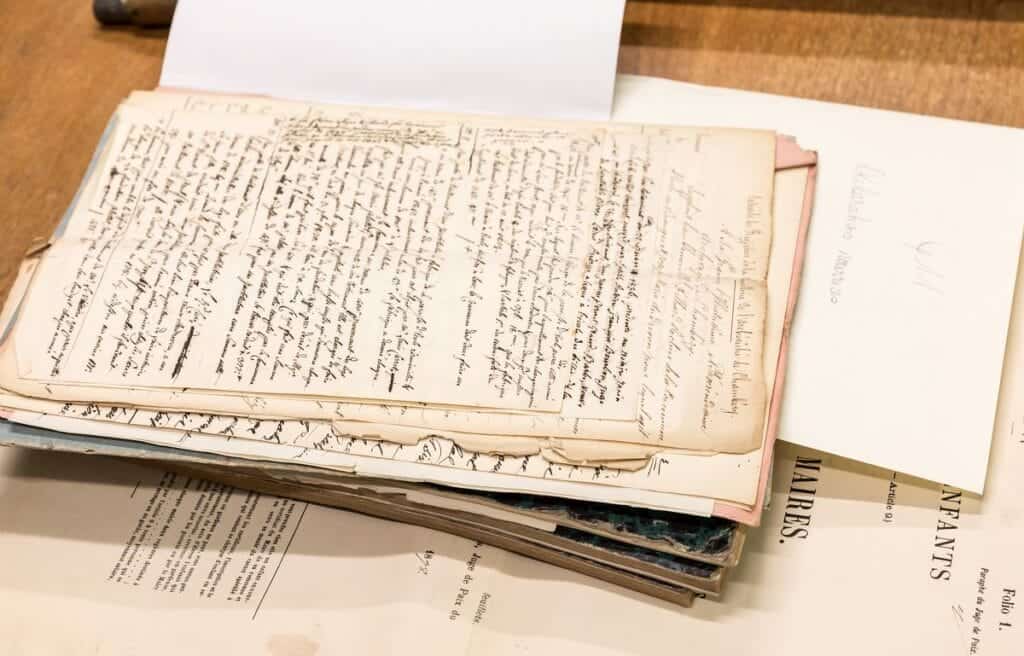
I work from the original records
Civil registers, parish books, ten-year indexes, military and notarial files: I consult them at the Moselle Departmental Archives (AD57) and online. Most records are in French; older parish entries are often in Latin, and annexation-era records in German. I know the standard formulas these records follow — and when a passage goes beyond them, I tell you so rather than guess.
Every fact in your file is linked to a source — and anything uncertain is clearly flagged, never presented as certain.
Free quote within 2 business days
No obligation
Fixed prices
Agreed upfront — no surprises
No commitment
Feel free to just ask
Worldwide
Serving Lorraine descendants everywhere
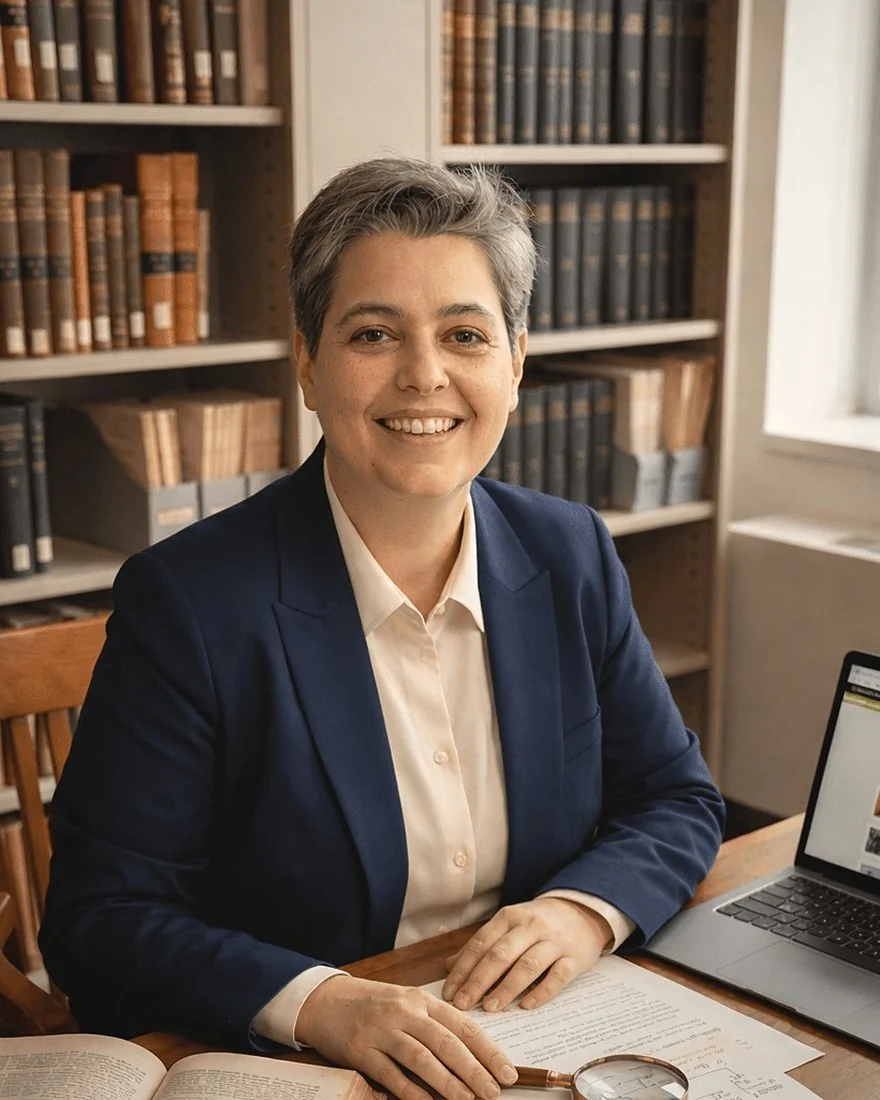
Genealogy Research for Your Lorraine Ancestor
I’m Stéphanie Perrin, a professional genealogist trained at the IFFG (Institut Français de Formation à la Généalogie), based in Moselle, France, and focused on its French- and German-era records. Whether you’re in the United States, Australia, or anywhere else your family’s journey has taken you, I help descendants of Lorraine families rediscover their roots. All my rates are fixed in advance, so you always know what you’re paying — free quote within 2 business days, no obligation. My research draws on the Moselle Departmental Archives (AD57) and Franco-German record collections.
Behind Every Name, a Story
I became a genealogist because I believe every family deserves to know where they come from — not just names and dates, but the choices, hardships, and quiet courage behind them. Moselle’s history is complicated, and so are many of the families who left it. I approach every search with the same care I’d want for my own family: rigorous, honest about what the archives can and can’t tell us, and handled with respect for whatever the records reveal.
Moselle Genealogy: Why Your Lorraine Ancestor's Records Are Different
If your ancestor came from the Moselle department, the eastern part of Lorraine along the German and Luxembourg borders, their paper trail is unlike anywhere else in France. Knowing why is the key to finding them.
- Two annexations. Moselle was part of the German Empire from 1871 to 1918, and was annexed again from 1940 to 1944. During those years, civil records were kept in German, often in Kurrent handwriting on printed German forms.
- Towns with two names. The same village can appear under its French or its German name: Thionville is Diedenhofen, Sarreguemines is Saargemünd, Boulay is Bolchen. U.S. immigration papers may use either one, or simply say “Germany” or “Alsace-Lorraine”.
- Latin parish registers. Before 1792, baptisms, marriages and burials were recorded by the parish priest, often in Latin.
- Service in the German army. A man from Moselle called up during the annexation served in the German army, so his service record is not in the French military registers.
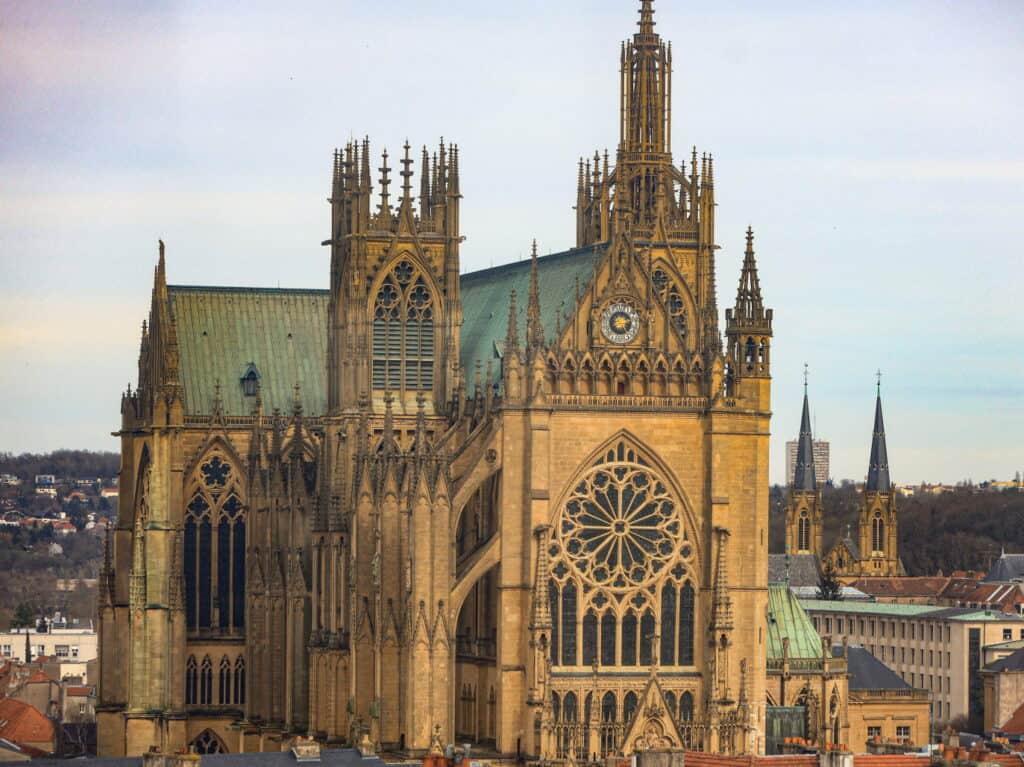
I work regularly with the Moselle Departmental Archives (AD57) near Metz, both online and in the reading room, working with records in French, and with the Latin and German formulas found in Moselle parish and civil registers. That is often what gets a stalled search (a “brick wall”) moving again.
Free guides for Lorraine descendants:
Why Work With Me on Your Lorraine Research?
What sets this research apart: a genealogist based in Moselle, who knows how its French- and German-era records are organised and where to look for them.
Free Quote Within 2 Business Days
No cost, no obligation. Your personalized quote is ready within 2 business days.
Fixed, Transparent Pricing
Once you accept your quote, its price no longer changes — you know exactly what you’re paying before we start.
Sourced File Included
Your family tree, the records found and a sourced summary.
Franco-German Moselle Archives
Research in the Franco-German archives of Moselle, including records from the German period (1871–1918).
Confidential by Default
Your family’s information is handled with discretion and is never shared without your consent.
Unlike an online search or family-tree software, I offer a human, documented and personalized investigation, carried out with a rigorous, source-based method.
Regular practice has made me familiar with Moselle’s older records: Latin parish entries, 18th-century French documents and the standard German forms of the annexation period. This is especially useful for research in Moselle and German-speaking Lorraine.
Professional genealogist trained at the IFFG | Based in Moselle, near Metz
How Your Research Unfolds
A simple, reassuring process — from your first message to your final report.
Step 1 — Request
Step 2 — Assessment
I analyze the feasibility of your project and define the exact scope of research: which branches to explore, which period, and which archives to consult. You receive a personalized, detailed quote.
Step 3 — Research
I consult the Moselle archives on your behalf: civil registration records, historic parish registers, military archives, and — where relevant — records on the 1940 expulsions.
Step 4 — Verification
Every piece of information is linked to at least one source, and cross-checked whenever the records allow. I clearly distinguish what is confirmed, probable, possible, or unproven before it goes into your file.
Step 5 — Delivery
You receive your file: a structured family tree, the archival documents found, and a written, sourced summary — with areas of uncertainty clearly flagged.
Simple, Transparent Pricing
Most of my clients — in France and abroad — start with a custom investigation: one precise question about your family, answered with sources. Complete family trees are available too, and grow only as far as you want to take the research.
START WITH ONE QUESTION
Have one precise question about your family? Start here — or trace a single line, without the cost of researching every branch.
| Option | What it covers | Price |
|---|---|---|
| Custom Investigation — most requested | One precise question: a missing link, an unknown ancestor, a family story to verify, or records for a citizenship-by-descent application. You receive a structured, sourced report. | From €150 |
| Single-Line Research | Trace one branch — paternal or maternal — over 4 generations | From €210 |
WANT THE COMPLETE PICTURE? (BOTH SIDES OF THE FAMILY)
| Package | Generations | What you receive | Price |
|---|---|---|---|
| Discovery | 4 generations (15 people) | PDF family tree, ancestry chart, folder of records found | From €380 |
| Heritage | 5 generations (up to 31 ancestors) | Large-format tree, family presentation booklet, timeline + GEDCOM file | €690 |
| Legacy | Multi-generation, custom scope | Complete file, large-format tree, timeline, GEDCOM, phone consultation | From €990 |
Terms
Conditions that apply to every project.
Free, personalized quote for every project.
Up to €150: full payment when you order. Above €150: 30% deposit to begin research; balance due on delivery.
Payment security: my bank details never change by email. If you receive a message with new bank details, do not make any payment and call me on +33 7 81 56 71 96.
VAT not applicable, art. 293 B of the French General Tax Code (CGI); art. L.233-3 of the French Tax Code on Goods and Services (CIBS) from 1 January 2027.
International research, foreign archives, or particularly complex cases (“brick walls”): custom quote, based on a rate of €85/hour, adjusted to the scope of your request. Once you accept the quote, its price is fixed.
Optional — official-use file: on request, your results and their sources are presented so they can be passed on to a notary or an administration (citizenship application, civil status correction). This file is not a legal document.
Optional — ongoing record watch: I monitor newly digitized archives concerning your family (AD57, censuses, civil records) and let you know as soon as a new lead opens up.
FAQ
Your questions, my answers
Do I need to be in France for this to work?
Not at all. I work entirely remotely — by email, phone, or video call — and most of the archives I use are digitized or held locally in Moselle. Nothing about the process requires you to travel, and I regularly work with clients across the United States, Australia, and beyond.
How will I receive my family history report?
Everything is delivered digitally as a PDF you can download, print, and share with family anywhere in the world.
How do I pay from abroad, and in what currency?
All prices are set in euros. You can pay by international bank transfer or through Wise, which usually keeps conversion fees low. Orders up to €150 are paid in full when you order; above €150, a 30% deposit starts the research and the balance is due on delivery. Bank and transfer fees are paid by the client.
Can I receive my report in English?
Yes. On request, your report can be written in English, even though the research itself draws on French- and German-language records. French terms with no exact English equivalent (such as « tables décennales », the ten-year indexes of civil records) are kept in French with a short explanation.
Can you obtain recent records (less than 75 years old)?
In France, birth and marriage registers only become open to the public 75 years after they are closed. Death records are not subject to this delay. For a more recent record, the person concerned, their spouse, their ascendants or their descendants can request a full copy (« copie intégrale ») from the town hall where the record was registered (see Service-Public). I can tell you which town hall to contact and how to word the request.
Can your research support a citizenship-by-descent application?
I find and gather the records that show the line from your ancestor to you, with full archival references, in a file you can submit. I am not a lawyer: the authority handling your application decides, and it sets the documents it requires (recent certified copies, translations, apostille…). Please check those requirements first, and I will plan the research around them.
Is my information kept confidential?
Yes. What you share is used only for your research and is covered by professional confidentiality. I use digital tools in my work (storage, email, writing aids including AI); details are in my privacy policy. No information about living people is ever published.
Is Moselle the same as Lorraine?
Moselle is one of the four departments of Lorraine, in north-eastern France, on the German and Luxembourg borders. Its main towns are Metz, Thionville, Sarreguemines, Forbach and Sarrebourg. If your family papers mention Lorraine, Lothringen or Alsace-Lorraine, your ancestor may well come from Moselle.
What records exist for a Moselle ancestor?
Civil registration of births, marriages and deaths from 1792, parish registers (often in Latin) before that, German-language civil records from 1871 to 1918, censuses, military records (French or German depending on the period) and notarial records such as marriage contracts and estate inventories. Many are online on the Moselle Archives website; others can only be consulted in the reading room near Metz, which is where I come in.
What about records written in old German script?
Moselle was annexed by Germany from 1871 to 1918 (and again 1940–1944), and many records from those periods are written in German — often in Kurrent, an old handwriting that most people can no longer read.
I’m not a German-language specialist, but I know the standard wording of these civil and parish records well, and knowing these recurring formulas lets me pick out the key information: names, dates, places and parents. When an entry is especially difficult, I tell you honestly what could be read with certainty and what remains uncertain — nothing in your file is guessed.
How long does a full ancestor-research project take?
It depends on the package you choose and the availability of records for your specific family line. I’ll give you a realistic estimate together with your free quote, based on an initial look at what’s involved.
What if the research uncovers something difficult?
Family history sometimes includes painful chapters — a hidden birth, a wartime choice, a name changed to leave something behind. If that happens, I share what I find with care, and you decide how much you want to know and how to pass it on.
Was my family really German, or French?
Moselle changed hands between France and Germany four times between 1871 and 1945. I untangle which records apply to your ancestor, and when.
My ancestor’s name is spelled differently in American records — can you find the original?
Contrary to a popular story, names were not changed by officers at Ellis Island: passenger lists were drawn up at the port of departure. But spellings do vary from one record to another, especially for French and German names in English-language documents. Starting from what you know, I search the Moselle civil and parish registers under the possible spellings, and tell you clearly whether the link can be confirmed.
There's a family story about nobility, a name change, or a scandal — is it true?
I check family legends against the actual archives and tell you, with evidence, what holds up and what doesn’t.
We think a relative was displaced during WWII — what happened to them?
I research the 1940 expulsion of Moselle families to the free zone, using departmental and military archives.
I already have a family tree, but I'm not sure it's accurate.
I verify existing research branch by branch, correct errors, and add sources where they’re missing.
My question doesn't fit into a neat category.
That’s more common than you’d think. Tell me what you’re trying to find, and I’ll tell you honestly whether — and how — it can be researched.
Ready to Reconnect With Your Lorraine Roots?
Tell me what you know about your Lorraine ancestor — even just a name and a rough date — and I’ll get back to you within 2 business days with a free, no-obligation quote. Wherever you live today, let’s see together what the archives can tell you.
Tell me about your ancestor
A name, a village, a rough date — whatever you know is a good start. I read every message myself and reply within 2 business days.